Analog Dessert instrument
Oscillato
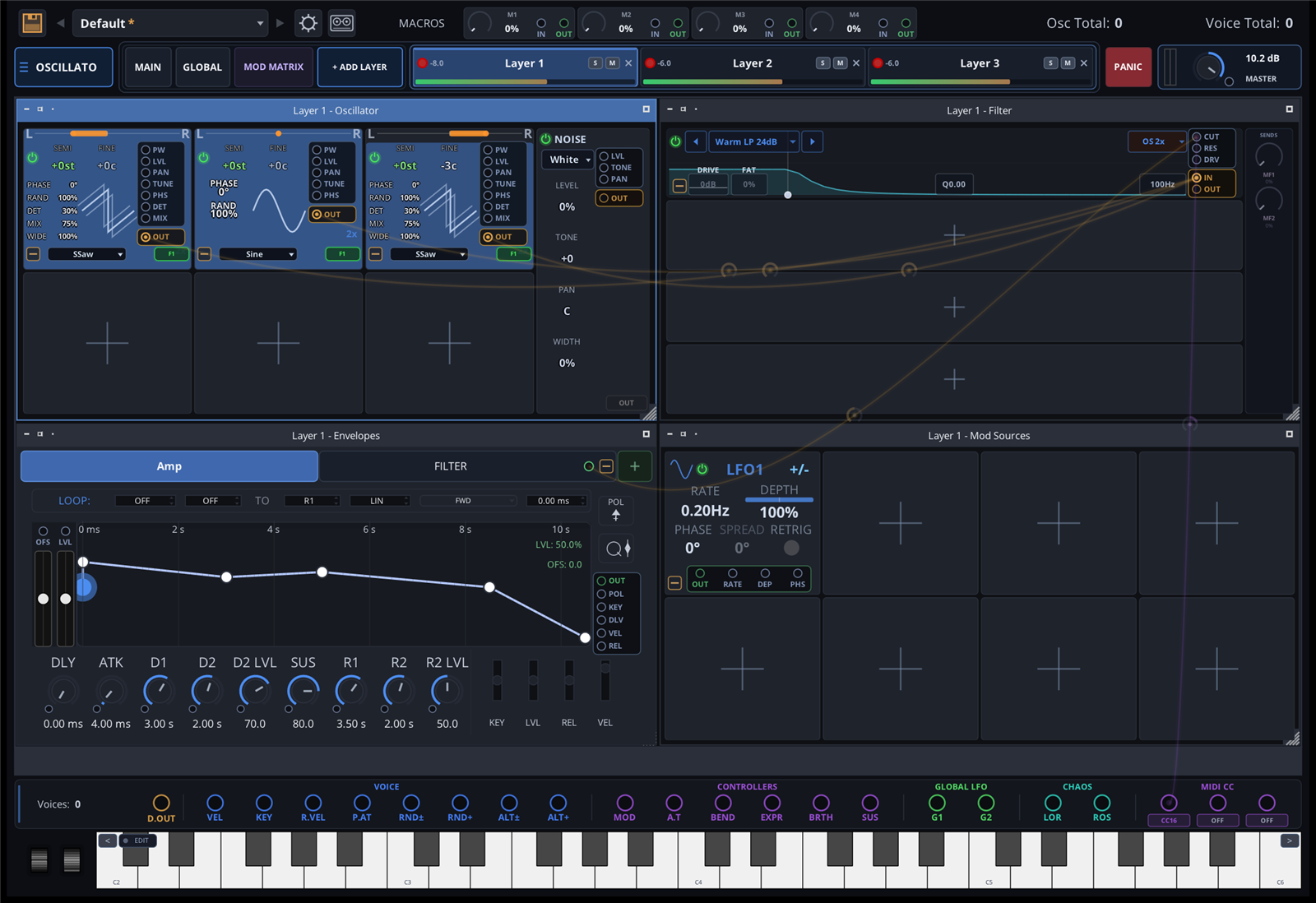
A warm, vintage-inspired modular polysynth for insanely huge pad stacks — Andromeda A6 depth, Oberheim Eight Voice architecture, ARP 2600 patch cables. And the first synth with MCP support.
-
A Poly-Polysynth. Make synths within synths.
Click + to add "Layers" -- each Layer can be up to 6 Oscillators, 4 Filters, 8 LFO's, 16 Envelopes.
A single note or chord can result in thousands of oscillators. Route anything to anything.
-
7 Stage Envelope(s).
Not ADSR. DADDSRR. Two Decay Stages. Two Release Stages. Multi-Swells. Have you ever wanted each parameter to come alive at different times? Just click + to create a new envelope and assign it to any parameter.
-
Vintage Inspired
True Stereo Filters. Analog Warmth. needed a replacement for all my hardware synthesizers, and ended up with something greater than all of them combined. As a programmer for 25+ years, and producer for 15 years, I know what good sounds like -- and now I never use the hardware.
-
Modular Routing
Signal and modulation share the same cables, like an ARP 2600. Click and drag oscillator to filter for audio, LFO to a jack to modulate. A mod matrix to see all the connections in a list.
-
Vintage warmth by design
Per-oscillator drift and phase, a level-holding SuperSaw, and per-slot drive give the rounded, slightly unstable tone of old polys.
-
API & MCP Support
You can control the synthesizer with API, or MCP. The first synth with MCP support: 100+ tools to script patches, generate presets, or create patches with help from assistant like Claude or an LLM.
-
Many Synthesizer Engines
Subtractive, Wavewarm, FM. Mix and match any combination of oscillator types within a layer.
Oscillato is a warm, vintage-inspired modular polysynth — and, as far as I know, the first synth with MCP support. It is built for insanely huge pad stacks, layered voices, and modular-style patch-cable routing. Every note or voice can have its own oscillators, filters, and envelopes. In short: my secret weapon I built by myself, for myself, finally opened up to the world.
It is for sound designers, composers, and top-tier synthesis experts. You have to know your way around a modular or understand synthesis, deeply.
Example Demos (Recorded straight out of Oscillato from it’s 1-click direct output — no DAW, no effects, or post-processing)
- PBS-80 – A patch with 3 Layers. This shows the complexity of Oscillato, having many “Synths” within a single patch!
- Layer 1 is my take on a CS-80.
- Layer 2 Is a Sample & Hold sound that slowly comes in
- Layer 3 Is a bell sound that is only assigned to the higher octaves MIDI
- Init Patch
Regular price: $150
Beta price: $49
Explore the instrument
Open a topic when you want the details. The rest stays out of the way.
The hardware I always wanted, in one plugin
I made Oscillato for me, by me. Specifically, I wanted a replacement for all my hardware that I could use on the go — something like an Oberheim Eight Voice VST, an Alesis Andromeda A6 VST, or a Voyetra 8 VST. None of those exist, so I built the next best thing.
I wanted my favorite analog polysynths’ features and sound in one place: the depth of an Andromeda A6 in Mix Mode, with the ability to give each note or voice its own filters, envelopes, and oscillators like an Oberheim Eight Voice. With the clarity of seeing the routing with visual patch cables, like an ARP 2600. But, with modern niceties — like holding Ctrl-Z to undo for ages 🙂
It is in beta now. I want you to play with it. I think you will like it.
Build a modular polysynth from parts
Most synths give you a fixed voice. Instead, Oscillato gives you parts and layers to build with.
A layer is basically a synth. Inside each layer, you can build with oscillators, filters, envelopes, LFOs, sample & hold, modulators, and patch cables. Per layer, that means up to:
- 6 oscillators
- 4 filters
- 16 envelopes
- 6 LFO / sample & hold modulators
- freely routable modulation
Need another envelope? Click +.
Need another oscillator? Click +.
Need a modulator to wiggle one weird little corner of the patch? Add it and wire it up.
That is the core idea of Oscillato: do not force every sound through one fixed synth architecture. Build the architecture the patch actually wants — quickly, easily, and visually.
Envelopes. Plural.
This is one of the things I kept wanting in other synths. Not just “the amp envelope” or “the filter envelope.” Envelopes. Plural.
And these are not your average 4-stage ADSR envelopes, either. We have 7-stage envelopes — an idea I got from my Alesis Andromeda A6, and one I have not seen in other soft synths. Because there are two decay stages and two release stages, you can make a swell that decays and then swells again. As a result, these envelopes are amazing for pads.
If you want one envelope for the filter, another for oscillator pitch, another for pulse width, another for detune amount, another for panning, and another just to slowly open one tiny motion path in the patch — you can do that. Moreover, you can give each oscillator its own envelope. You can make evolving pads where every part of the sound wakes up at a different time.
In other words: patches that breathe, drift, bloom, and mutate — instead of just opening one filter and calling it movement. But, there are main filters too, that can apply to all layers if needed for a glued sound across all the layers.
16 synths inside one synth
Oscillato gives you up to 16 layers, and each layer can be its own full synth structure.
For example: one layer can be a bass, one a drifting pad, one a noisy attack transient, one a sub layer, one a slow shimmer that only appears on high notes, one unstable and detuned, one clean and centered.
Then the voice router decides where your notes go. A note can hit one layer, all layers, round-robin layers, random layers, key zones, velocity zones, chord-position layers, and more — 15 routing modes in total, built on the same note-routing engine as my Pie Plate router.
This is where Oscillato stops feeling like “one synth patch” and starts feeling like a stack of instruments living inside one plugin. Oberheim Eight Voice meets Andromeda A6 Mix Mode energy — except you do not need to suffer to program it. My pad machine. I LIKE THE PADS!!!
Thousands of oscillators, because apparently I have a problem
Here is the ridiculous part: each layer can, in theory, run up to 6 Super Saw oscillators, and each Super Saw contains 7 detuned saws. Therefore, one note can trigger 42 saw oscillators from a single layer. Now spread that across 16 layers: that is 672 saw oscillators from one note. Play a three-note chord and you could, in theory, be running 2,016 saw oscillators at once.
Is that excessive? Yes.
For the record, my Super Saw implementation is my personal favorite: the widest, phattest, and inspired by years of owning the original JP-8000. Beyond that, Oscillato includes sine, saw, triangle, PWM, square, and wavetable oscillators — with drawable, loadable, and saveable wavetables — plus microtonal scale support.
The first synth with MCP support
This is the part I am most excited about — and, honestly, a little scared to talk about.
Oscillato exposes a programmable control surface for the instrument: 100+ tools over MCP and API for controlling internal synth parameters. You can script patches, generate preset libraries, and control the instrument in ways no other synth currently supports. As far as I know, no other synth ships this — which makes Oscillato the first synth with MCP support.
What a synth with MCP support can actually do
Say “make me a slow, evolving, dark, warm, vintage pad,” and an assistant like Claude can help build something straight out of Blade Runner territory. It can script the synth live, batch-generate preset libraries overnight, or simply explain how an unfamiliar patch is wired. The server stays off until you enable it.
A synth with MCP support, minus the hype
To be clear: I am not into fully AI-generated music, where the instrument, the performance, and the lyrics are all synthetic. There is no humanity in that. However, opening up the internals of the synth can help me — or you — express what you actually want to hear, in a natural, intuitive way.
The layout is built the way people learned synthesis back in the day, with everything wired in front of you: if you couldn’t see it, it probably didn’t work. Seeing how a sound is patched, with a little help, is a way to learn. The API is just another way to reach into the instrument. Use at your own risk!
Frequently asked questions
Is there a Voyetra 8 VST, an Oberheim Eight Voice VST, or an Andromeda A6 VST?
Not officially — none of those instruments have an official plugin version. Oscillato is not an emulation of any of them, either. Instead, it chases the thing that made them special: every voice as its own complete synth, with its own oscillators, filters, and envelopes. If you have been searching for that per-voice architecture in plugin form, that’s not too ‘scientific’ to program in an experimental manner, this is the closest thing I know of — because I searched too, and then built it.
Which synths have MCP support?
As far as I know, Oscillato is currently the only one. I am not aware of any other synthesizer with native MCP support, which is why I call it the first. If others appear, welcome — the more instruments open up their internals, the better.
What should I know before buying?
Oscillato is a beta release at a beta price, made for me, by me — it is my baby, and I will do my best supporting it. Because it is beta, some things may still change: preset compatibility, future formats, functionality, price, availability, and support responsiveness. There is no full manual yet, because I know what everything does. Oops. However, tooltips are everywhere, so it is at least trying to be self-documenting 🙂
This thing can push hard — especially with driven filters, huge layer stacks, and absurd oscillator counts. That is part of the danger and part of the fun. It might sound as good as a synth ever gets.
Get Oscillato
Explore the massive sonic potential of Oscillato Beta.
Regular price: $150 · Beta price: $49, one-time.